
ADVERTISEMENTS
If you've ever downloaded a free game on your phone and wondered, "How do they make money from this?", you're not alone. The mobile gaming market generates billions of dollars annually, and understanding how this money-making machine works is fascinating.
The truth is that developers have created super clever monetization models that allow you to play for free while they line their pockets. And look, there's nothing wrong with that – it's a fair deal when done well.
Let's dive deep into this universe and discover all the secrets behind the monetization of the mobile games you love to play.
What is monetization in mobile games?
Monetization is basically how developers turn their game into a source of revenue. Think of it this way: creating a game is expensive; it involves programmers, designers, artists, servers, and a whole lot of other people.
In the past, you bought a game and that was it. Nowadays, especially on mobile, things have completely changed. Games are generally free to download, but that doesn't mean they're free for developers to create.
Therefore, several monetization models have emerged that allow you to play without paying anything, but also offer options for those who want to invest a little money and gain advantages or improve their experience.
Free-to-Play: The Model That Dominated the Market
The model Free-to-Play (F2P) It's by far the most popular mobile game. The idea is simple: you download the game for free and can play as much as you want without spending a penny.
But don't worry, the developers aren't charities. They make money through in-game purchases and advertising. It's a model that has democratized gaming, allowing anyone with a smartphone to have fun.
The secret to F2P success lies in finding the perfect balance: keeping the game fun for those who don't pay, but attractive enough that some players want to spend money.
Advantages of the Free-to-Play Model
- Zero barrier to entry – anyone can download and play.
- Much larger player base
- The possibility of testing the game before investing money.
- Constant updates and new content.
- A more active and engaged community.
Disadvantages of the Free-to-Play Model
- It can create unfair advantages for those who pay (pay-to-win).
- The constant presence of advertisements can be irritating.
- Temptation to spend more than planned.
- Some games become very limited without paying.
- Mechanisms designed to encourage spending can backfire.
In-App Purchases
To the in-app purchases They are the heart of mobile monetization. They can take many forms, from virtual currencies to special items, exclusive characters, or features that make your life easier in the game.
There are basically two types: consumable purchases (which you use and then run out, like gold coins) and non-consumable purchases (which you keep forever, like removing ads or unlocking a character).
Developers are masters at creating tempting offers. That special package with a 50% discount that only appears once? It's pure psychology to get you to open your wallet.
Most Common Types of In-App Purchases
To the premium coins These are the most common type. You buy gems, diamonds, gold, or whatever creative name the game uses, and then spend those coins on special items within the game.
You startup packages They're also super popular. They offer a bundle of features with a special discount for new players, creating that feeling of "I need to take advantage of this unique offer.".
There are also Battle Passes Or season passes, which have become a craze. You pay once and unlock rewards as you play and complete challenges during a specific period.
Advertising System: Watch to Earn
You advertisements They are another gigantic source of revenue for mobile games. You've probably seen millions of them: those 30-second videos that appear between levels or when you want to earn an extra reward.
There are several ad formats. The most common are banners (those little bars at the top or bottom of the screen), interstitial ads (which take up the entire screen), and reward ads (where you watch voluntarily to earn something).
The model of rewarded ads It's brilliant because everyone wins. You get extra lives, coins or boosters, the developer makes money, and you don't feel forced to watch.
How Developers Make Money from Ads
Developers work with ad networks that pay per impression (CPM – cost per thousand impressions) or per click (CPC – cost per click). The more people play, the more ads are displayed, and the more money is made.
A game with millions of active players can rake in a fortune from ads alone, even if no one makes in-app purchases. That's why many casual games rely heavily on this model.
The key is not to overdo it. Filling the game with annoying ads can make players uninstall it quickly, so smart developers find the ideal balance.
Subscription Model: Recurring Payment
To the signatures They are growing rapidly in the mobile world. It works like Netflix: you pay a monthly fee and receive ongoing benefits as long as you keep your subscription active.
This could include access to exclusive content, ad removal, daily premium coins, permanent boosters, or a combination of all of these. The best part is that you know exactly how much you'll spend each month.
For developers, this model is wonderful because it guarantees a predictable and consistent revenue stream. It's much better than relying solely on sporadic player purchases.
Pay-to-Win vs Pay-to-Progress: The Great Controversy
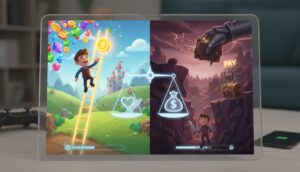
This is where one of the biggest debates in the gaming community takes place. Pay-to-win This happens when those who pay have such a large advantage that it becomes impossible to compete without spending money. This is extremely frustrating for players who don't want to or can't afford to pay.
Already pay-to-progress This is when paying only speeds up your progress, but doesn't give you unfair advantages. You can achieve everything by playing for free, it will just take longer. This model is generally more well-received.
The most successful games in the long run are those that respect free-to-play players, offering a complete and fun experience even without spending any money.
Gacha and Loot Boxes: The Luck System
The system gacha It comes from Japanese games and works like those gumball machines with surprise toys. You spend coins (usually premium coins) for a chance to win rare characters or items.
To the loot boxes They follow the same principle: you buy a mystery box without knowing exactly what's inside. It could be something incredible or something ordinary – it's all based on probabilities.
This model is extremely profitable because it plays on the players' psychology. The thrill of opening a box and the possibility of getting something rare is addictive for many people.
However, this system is controversial. Some countries already consider it a form of gambling and are creating regulations. Many players criticize it because it can lead people to spend a lot of money without any guarantee of getting what they want.
Power System and Waiting Time
You know when you're playing a game, super excited, and suddenly your power runs out? Then you have to wait hours to recharge or... spend premium coins to continue playing immediately.
This is the power system, It's a monetization mechanic disguised as gameplay. It limits how long you can play at once, creating the urge to pay so you don't have to stop.
Constructions that take 24 hours to complete, upgrades that take days, endless cooldowns – all of this is designed to make you consider spending money to speed up the process.
Personalized and Dynamic Offers
Modern games use artificial intelligence and data analysis to create personalized offers for each player. That's right, that special offer that appeared for you may be different from the one your friend received.
If the system detects that you're stuck on a difficult level, it may offer you a discounted power-up pack. If you haven't played in days, you may receive a welcome offer to bring you back.
This personalization greatly increases the chances of conversion because the offer arrives at the right time, when you are most likely to accept.
Limited Events and FOMO
You limited-time events They are a powerful monetization strategy. They create that "now or never" feeling, known as FOMO (Fear of Missing Out).
During these events, exclusive items, special characters, or offers appear that will only be available for a few days. This puts pressure on players to spend money so they don't miss out on the opportunity.
Seasonal events, holiday events, special collaborations – all of this keeps the game fresh and gives players constant reasons to come back and potentially spend money.
The Premium Model: Pay Once and Play Forever
Although less common on mobile, premium model It still exists. You pay a fixed price to download the game and have full access to everything, without ads or additional purchases.
Premium games typically cost between R$ 10 and R$ 50, depending on quality and complexity. They are common in ports of console games or indie titles from smaller developers.
The advantage is clear: you pay once and that's it, no surprises or temptations to spend more. The disadvantage for developers is that the revenue stops after the initial launch.
How Developers Choose the Ideal Model
The choice of monetization model depends on several factors: game type, target audience, competition, and the developer's financial goals.
Casual games with short sessions generally work best with ads and small in-app purchases. Competitive games or complex RPGs, on the other hand, benefit more from gacha systems, battle passes, and subscriptions.
Ideally, several models should be combined in a balanced way. A game could have optional ads, some in-app purchases, and perhaps a premium subscription, giving options to different types of players.
The Future of Mobile Monetization
The market is constantly evolving. New technologies like blockchain and NFTs are starting to appear in some games, promising that players can actually own and trade digital items.
The trend is for models to become increasingly sophisticated and personalized, using data and AI to create unique experiences for each player, maximizing both fun and monetization.
At the same time, pressure is growing for regulation and transparency, especially regarding loot boxes and the protection of minors. Developers will need to find a balance between profit and ethics.
Ultimately, understanding how monetization works helps you make more informed decisions about your gaming spending. You can enjoy the games you love without falling into psychological traps or spending more than you intended. And the best games are those that manage to be profitable without exploiting their players – a true win-win for everyone involved.