
ADVERTISEMENTS
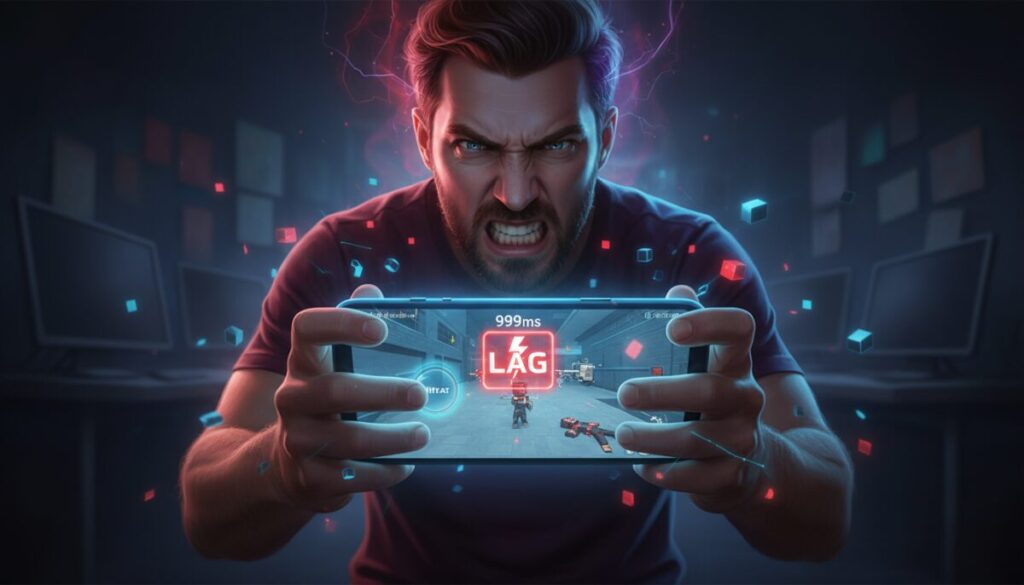
If you've ever played any competitive mobile game, you've probably experienced that frustrating moment: you aim perfectly at your opponent, press the fire button, and… nothing happens. When the action finally registers, you're already dead. Welcome to the world of latency, the invisible enemy of every competitive gamer.
Latency, also known as ping or lag, This is basically the time it takes for your device to communicate with the game servers. And in competitive mobile games, where every millisecond counts, this delay can be the difference between a glorious victory and a shameful defeat.
Let's delve deep into this subject and understand how this technical phenomenon can ruin (or improve) your gaming experience.
What exactly is latency?
Think of latency as the reaction time between you and the game. When you tap the screen to perform an action, that information needs to travel from your phone to the game server, be processed, and then come back to you and all the other players in the match.
This time is measured in milliseconds (ms). To give you an idea, a latency of 20ms is considered excellent, while anything above 100ms starts to negatively affect your gameplay in competitive titles.
Latency isn't just a boring number on the screen. It literally represents how many milliseconds you are "behind" what's actually happening in the game. It's like watching a live stream with a few seconds of delay.
Why is latency critical in competitive mobile gaming?
In competitive games, especially titles like PUBG Mobile, Call of Duty Mobile, Free Fire, or Mobile Legends, matches are decided by fractions of a second. A player with 30ms latency will have a significant advantage over someone playing with 150ms.
Imagine a direct duel between two players of equal skill. Both aim and shoot at the same instant. However, the player with the lower latency will have their shot registered first on the server, guaranteeing their elimination. The other player, even having shot simultaneously from their point of view, will already be dead before their action is processed.
This creates a situation where Connection becomes as important as skill.. You can have the best aim in the world, the fastest reflexes, but if your latency is high, you'll always be at a disadvantage.
Specific Impacts by Game Genre
In Battle Royales In games like Free Fire and PUBG Mobile, latency directly affects firefights, the ability to quickly pick up items, and even your movement around the map. A one-second delay can mean missing a vehicle in time or losing that crucial weapon at the start of the match.
Us MOBAs mobile In games like Mobile Legends and League of Legends: Wild Rift, latency compromises your ability to execute skill combos, dodge enemy attacks, and effectively participate in teamfights. In these games, where positioning and timing are everything, playing with high lag is virtually impossible at competitive levels.
Already tactical shooting games In games like Valorant Mobile or Call of Duty Mobile, latency directly affects your perceived accuracy and reaction time. You might be aiming perfectly at the enemy's head, but if there's latency, the server might register that the opponent has already moved from that position.
The Main Causes of High Latency
Understanding what causes latency is the first step in combating it. Several factors can contribute to that high ping that's ruining your games.
- Distance from the servers: The farther you are from the game server, the higher the latency will be. Playing on international servers when local servers are available is a common mistake.
- Internet connection quality: An unstable, congested, or simply slow connection will result in high and inconsistent latency.
- Connection type: Mobile data (4G/5G) versus Wi-Fi can have very different latencies, depending on the quality of each.
- Other devices on the network: If multiple people are using the same Wi-Fi connection for streaming, downloading, or other gaming, your latency will increase.
- Problems with the game server: Sometimes the problem isn't on your end. Overloaded servers or technical issues affect all players.
- Device processing: A mobile phone with weak hardware can add extra latency when processing game information.
How to Measure Your Latency
Most modern competitive mobile games display your ping somewhere in the interface. It usually appears as a number followed by "ms" in the upper corner of the screen, often accompanied by a color indicator (green for good, yellow for average, red for bad).
But it's important to understand that there are different types of latency. average ping It's what you see on the screen, but there's also the jitter, This refers to the variation in latency. You might have an average ping of 50ms, but if it fluctuates between 30ms and 150ms, the experience will be terrible.
Some games also show indicators of packet loss (Packet loss), which occurs when information sent between you and the server is simply lost along the way. This results in teleports, actions that don't register, and other frustrating problems.
Practical Strategies to Reduce Latency
Now let's get down to business: how to improve your latency and gain a competitive edge. There are several strategies you can implement immediately.
Optimizing Your Internet Connection
The first and most important step is to ensure that you are using the best connection available. If possible, use 5GHz Wi-Fi instead of 2.4GHz, as it offers less interference and higher speed. Stay close to the router to ensure a strong signal.
If you're using mobile data, make sure you have adequate 4G or 5G coverage. Sometimes, poor Wi-Fi can be worse than good mobile data. Test both options and see which offers lower latency in your specific case.
Consider investing in a better internet plan If you play competitively frequently, the difference between a basic plan and a gaming plan can be significant in terms of latency and stability.
Device and Game Settings
Close all background applications that may be using internet or processing power. Streaming apps, social media, and automatic updates can steal bandwidth and increase your latency.
Activate the game mode From your mobile phone, if available. This function prioritizes device resources for the game, minimizing interruptions and optimizing performance.
Within the game, always select the nearest server Depending on your geographical location, playing on distant servers just to play with friends or avoid queues can be costly in terms of latency.
Equipment and Hardware
If you play via Wi-Fi, consider using a gaming router with QoS (Quality of Service), which prioritizes game traffic over other types of data. This can make a huge difference in homes with multiple users.
For the most dedicated, there is the option of using ethernet adapters for cell phones. Yes, you can connect your smartphone directly to the router via cable, completely eliminating Wi-Fi instability. It's an extreme solution, but effective.
Keeping your device updated is also crucial. Operating system updates often include connectivity and performance improvements that can reduce latency.
Advantages of Gaming with Low Latency
- Instant stock logging: Your commands are executed virtually in real time, without any noticeable delays.
- Advantage in direct combat: In shootouts, you will always have priority if both of you fire simultaneously.
- Better accuracy: The enemies are exactly where you see them, without the lag compensation that can cause you to miss shots.
- Fluid movement: Its movement across the map is smooth and responsive, allowing for more complex maneuvers.
- Less frustration: You know that when you lose, it's due to a lack of skill, not technical problems.
- Best performance in rankings: With all the advantages mentioned above, your chances of getting a promotion increase significantly.
Disadvantages of Gaming with High Latency
- Unjust deaths: You will be eliminated even after taking cover due to the delay.
- Unregistered commands: Skills and actions may simply not happen when you perform them.
- Enemies teleporting: The opponents' movements will appear erratic and unpredictable.
- Inability to compete at a high level: Professional and high-ranked players simply cannot play effectively with high latency.
- Frustrating experience: The constant feeling of fighting against the game itself, not just against the opponents.
- Waste of time and effort: Training and improving your skills has limited returns when latency is a limiting factor.
Myths and Truths About Latency
There's a lot of misinformation circulating about latency and how to deal with it. Let's clarify some important points.
Myth: VPNs always improve latency. True: In most cases, VPNs increase latency because they add an extra layer of routing. Only in specific situations, where your internet provider has poor routing to the game servers, can a VPN help.
Myth: Faster internet speeds mean less latency. True: Speed (Mbps) and latency (ms) are different things. You can have 1Gbps internet and still have high latency if the server is far away or your connection is unstable.
Myth: Mobile data always has worse latency than Wi-Fi. True: Modern 5G connections can have lower latency than Wi-Fi in many cases, especially if the Wi-Fi is of poor quality or congested.
The Future of Latency in Mobile Games
Technology is constantly evolving to reduce latency. The arrival of 5G It promises ultra-low latency, potentially reaching 1ms under ideal conditions. This would put mobile games on the same level as PC games with a wired connection.
Developers are also implementing lag prediction and compensation technologies more sophisticated. These systems attempt to predict where players will be and compensate for small latency differences, making the experience fairer for everyone.
Furthermore, the expansion of regional servers This means that more players will have access to nearby servers, naturally reducing latency. Companies are investing heavily in infrastructure to support the growing base of competitive mobile gamers.
When Latency Becomes Unacceptable
There comes a point where latency simply makes competitive gaming impossible. For most shooters and MOBAs, anything above that level becomes problematic. 150ms It is already considered virtually unplayable at a competitive level.
Between 100-150ms, you can still play, but you'll be at a clear disadvantage against players with better connections. Between 50-100ms, the experience is acceptable, but not ideal. Below 50ms, you're in the competitive zone where latency won't be your main problem.
If you consistently experience latency above 150ms while gaming, it might be time to seriously consider upgrading your internet infrastructure or accept that real-time competitive gaming may not be viable in your current situation.
Final Considerations
Latency is one of the most important, yet often overlooked, aspects of competitive mobile gaming. It can be the difference between being an average player and reaching the highest rankings.
Investing time and resources to optimize your latency is not an exaggeration if you take your gaming seriously. From small adjustments like closing background applications to larger investments like upgrading your internet plan, every improvement counts.
Remember that all professional and high-level gamers ensure they are playing with the lowest possible latency. They understand that skill and strategy can only shine when technology isn't getting in the way.
So, before blaming your reflexes or lack of skill for your next defeat, take a look at that ping number in the corner of the screen. Perhaps the real enemy is invisible, measured in milliseconds, stealing your victories before you even realize it.