ADVERTISEMENTS
If you enjoy playing games on your mobile phone, you've probably come across two very different ways to enjoy your favorite games. On one hand, there are games that you download directly from the app store. On the other, there are those that run in the cloud and reach you via streaming.
But what is the real difference between these two technologies? And more importantly: which one best suits your play style? Let's explore all of this in this comprehensive article!
What are native mobile games?
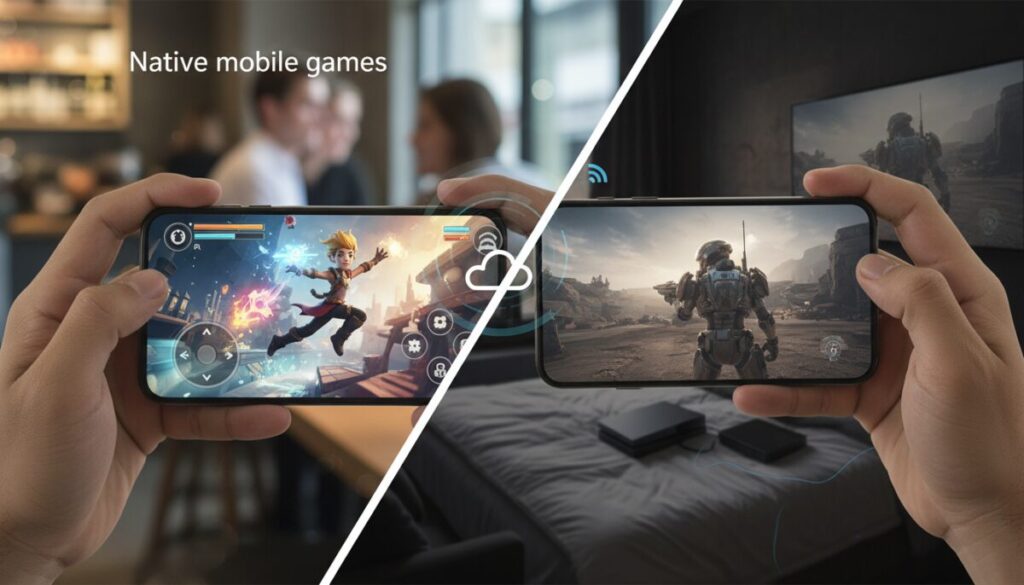
You native games These are the ones you know well: download them from the Google Play Store or App Store, install them on your phone, and you're good to go. The game is stored on your device and runs using your smartphone's own processor, RAM, and GPU.
Think about games like Free Fire, PUBG Mobile, Genshin Impact, or Candy Crush. They all need to be installed and take up space on your device. The more demanding the game, the more storage it will consume.
The main characteristic of native games is that they depend entirely on your cell phone hardware. If you have a top-of-the-line device, you'll be able to run demanding games just fine. But if your smartphone is more basic, you can forget about those ultra-realistic graphics.
How do games stream?
Streaming games, however, works in a completely different way. Here, the game doesn't run on your phone, but rather on... powerful servers in the cloud. What you see on the screen is basically a video streamed in real time.
Think of it like Netflix, but for games. Services like Xbox Cloud Gaming, GeForce NOW, and Amazon Luna are examples of this technology. You don't need to download anything large, just a lightweight application that acts as a "receiver.".
Your commands are sent over the internet to the server, which processes everything and returns the game images. All of this happens in milliseconds when the connection is good.
Main Technical Differences
Storage and Space
This is one of the most obvious differences. Native games can take up anywhere from a few megabytes to more than 10GB of your phone's storage. Genshin Impact, for example, easily exceeds 15GB with all updates.
With game streaming, you don't need to worry about that. The service's app usually takes up less than 100MB. Everything else is stored on the company's servers.
Processing and Performance
In native games, the Performance depends entirely on your hardware.. A Snapdragon 8 Gen 2 will run any mobile game at maximum graphics settings. A mid-range processor, however, will have to make compromises.
With streaming, theoretically you can play even the most demanding games on a basic mobile phone. The processing happens on servers, which are powerful machines. Your phone only needs to decode the video.
Internet connection
Herein lies a crucial difference. Native games can be played. offline In most cases (except for online multiplayer, of course). Downloaded the game? You can play on a plane, on the subway, or anywhere without internet.
Streaming games is completely dependent on a stable and fast internet connection. Without internet, you simply can't play. And it's not just any internet: it needs to be a high-quality connection, preferably above 10Mbps.
Advantages of Native Mobile Games
- Offline gameplay: It doesn't require internet to function.
- Zero latency: Instant response to your commands.
- Full control: The game is literally in your hands.
- No time limit: Play as much as you want with no subscription restrictions.
- Specific optimization: Developed with mobile hardware in mind.
- It does not consume mobile data. Once downloaded, play as much as you like.
- Better visual quality: When the hardware allows, the graphics are superior.
In addition, native games usually offer a more polished experience. The developers optimize every detail to run perfectly on different devices, adjusting graphics and controls specifically for touch screens.
Disadvantages of Native Mobile Games
- It takes up a lot of space: Some games may consume more than 10GB.
- Hardware limitation: Weak phone = poor graphics or games that won't even run.
- Huge downloads: Each update can mean gigabytes to download.
- Appliance heating: Demanding games cause the system to overheat and drain the battery quickly.
- Hardware wear and tear: Heavy use can reduce the device's lifespan.
- High entry cost: To play the best games, you need an expensive phone.
The storage issue is particularly problematic. Many people have phones with 64GB or 128GB of storage, and when you install two or three large games, the space runs out very quickly.
Advantages of Streaming Games
- It takes up no space: Play the biggest titles without filling up your phone.
- Irrelevant hardware: Basic cell phones can run AAA games.
- No downloads: Click, and you're already playing.
- Giant library: Access hundreds of games with a subscription.
- Battery saving: The processing does not take place on your device.
- Always up to date: The games already come with the latest versions.
- Play on any device: Did it start on your phone? Continue on your tablet or TV.
The ability to play console titles on your mobile phone is revolutionary. Imagine playing Forza Horizon, Halo, or Cyberpunk 2077 on your smartphone? With cloud gaming, this is entirely possible.
Disadvantages of Streaming Games
- It depends entirely on the internet: Bad connection = horrible experience
- Perceptible latency: There is always a slight delay between command and action.
- It consumes a lot of data: Your plan could easily go wrong.
- Variable image quality: Video compression can blur graphics.
- Recurring cost: You need to pay a monthly subscription.
- You do not own the games: Did you cancel your subscription? You lost access to everything.
- Regional availability: Not all services work in Brazil.
Latency is the Achilles' heel of streaming. In competitive games like shooters or fighting games, that 50-100ms delay can be the difference between victory and defeat.
Which one consumes more internet data?
This is a very common question. Native games consume internet data mainly during updates and online modes. A multiplayer game can use between 50MB and 150MB per hour of gameplay, depending on the title.
Game streaming, however, is much more demanding. We're talking about... 3GB to 10GB per hour, ...depending on the stream quality. If you play in 1080p with a high frame rate, you can easily exceed 8GB per hour.
For those with limited mobile data plans, this is a huge problem. An afternoon of streaming gaming can consume your entire data allowance.
The Latency Question
Latency is the time it takes between pressing a button and seeing the action happen on the screen. In native games, this latency is practically imperceptible, usually below 20ms.
With streaming, the story is different. Your command needs to travel over the internet to the server, be processed, and the image needs to come back. Even under ideal conditions, you're talking about... latency between 30-80ms.
For casual games, puzzle games, or RPGs, this doesn't make much difference. But in competitive games that require quick reflexes, this extra latency can be frustrating.
Graphic Quality: What to Expect?
In native games, graphical quality is limited by your hardware. A modern flagship can run games with console-like graphics, featuring high-resolution textures, dynamic shadows, and advanced lighting effects.
With streaming, theoretically you have access to maximum graphics which the servers can process. However, there's a catch: video compression. To stream over the internet, the images need to be compressed.
This means that even if the game is running on ultra settings on the server, what you receive may have compression artifacts, especially in scenes with a lot of movement or fine details.
Cost-benefit analysis: Which one is cheaper?
Native games generally follow free-to-play or one-time purchase models. Many of the biggest mobile hits are free, making money through in-game purchases. You don't pay anything to start playing.
Streaming services charge monthly fees ranging from R$ 25 to R$ 50 per month. Over a year, this represents R$ 300 to R$ 600. In return, you get access to hundreds of games.
If you play a lot and like variety, streaming might be more economical. But if you're one of those people who plays the same game for months, a recurring subscription might not be worth it.
What type of player is each one best for?
Native Games Are Ideal For:
Competitive players who need zero latency and maximum responsiveness. If you take your ranked matches seriously, you definitely need a native game running locally.
Those with unstable internet connections or who play on the go also benefit greatly. Being able to play on the bus, subway, or in areas without coverage is a huge advantage.
People with good smartphones who want to get the most out of the hardware they already own should also focus on native games.
Streaming Games Are Ideal For:
Casual gamers who enjoy trying out many different games. With a subscription, you have a huge library to explore without commitment.
For those with simpler phones but who want to play AAA titles, this is the most accessible way to access console games on mobile.
People with fast and stable internet At home. If you have fiber optic internet and primarily play games connected to Wi-Fi, the experience can be excellent.
The Future: Which Technology Will Dominate?
The truth is that we'll probably have room for both technologies. Native games aren't going away anytime soon, especially considering that not everyone has access to high-quality internet.
However, as internet infrastructure improves globally and 5G technology becomes more accessible, streaming is expected to grow significantly. Giant companies like Microsoft, Google, and Amazon are investing heavily in it.
Most likely, we will see one coexistence. Native mobile games will continue to be strong, while streaming establishes itself as a viable alternative for those who want more variety and access to console games.
Final Considerations
There's no definitive answer as to which is better. It all depends on your gaming profile, the quality of your internet connection, and the type of experience you're looking for.
Native games offer the best performance, zero latency, and independence from the internet. They are perfect for those who take gaming seriously and want the best possible experience.
Streaming games democratize access to AAA titles, eliminate storage issues, and allow you to play on any device. They are ideal for those who want variety and convenience.
The good news is that you don't have to choose just one. Many gamers keep a few favorite games installed natively and use streaming services to try out new titles. You can enjoy the best of both worlds!