ADVERTISEMENTS
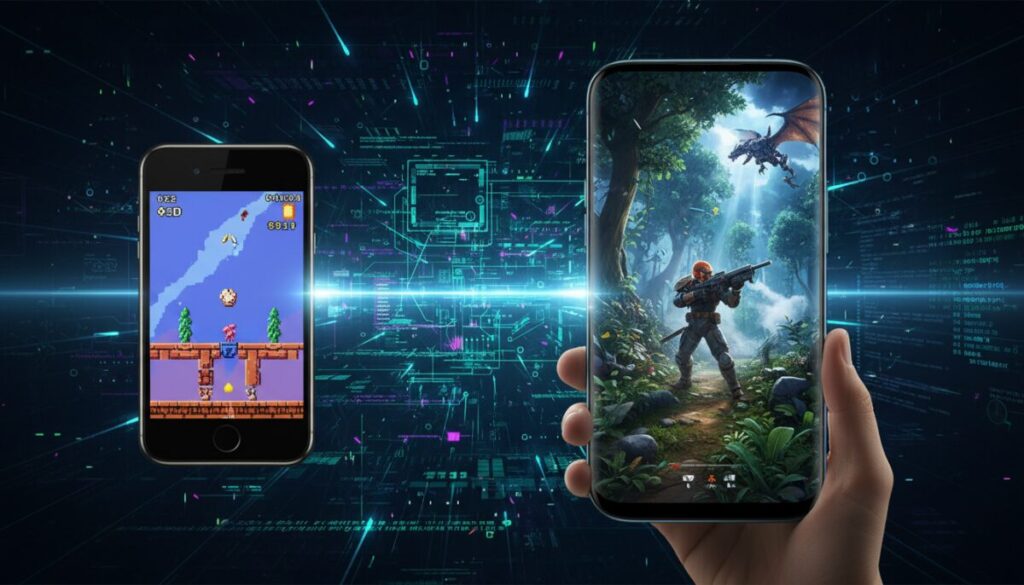
If you've been playing mobile games for a while, you've probably noticed how the graphics in mobile games have evolved dramatically in recent years. What used to be simple games with basic visuals have transformed into almost cinematic experiences that fit in the palm of your hand.
This entire revolution didn't happen by chance. Behind this impressive transformation are the... graphics engines, which are basically the technological heart of any modern game. Let's delve into this fascinating history and understand how we got here.
What exactly are graphics engines?
Before discussing evolution, I need to explain the basics. A game engine is like a car engine, but for games. It's a set of tools and technologies that developers use to create the visuals, physics, sounds, and the entire game experience.
Think of it this way: instead of programming every shadow, every light reflection, or every character movement from scratch, developers use an engine that already has these functionalities ready. This saves time and money and allows them to focus on creativity.
In the mobile world, these engines need to be even smarter. After all, your cell phone has much less processing power than a console or gaming PC, but you still want beautiful graphics without draining the battery in half an hour.
The Beginnings: When Everything Was Pixelated
Back in the early 2000s, the first mobile games were quite humble. Remember Snake on Nokia? That was practically programmed from scratch, without any sophisticated graphics engine. The graphics were 2D, super simple, and most games had that characteristic pixelated look.
Back then, developers created their own in-house systems for each game. It was too much work and severely limited what could be done. But as smartphones started appearing, everything changed rapidly.
With the launch of the iPhone in 2007 and the popularization of Android soon after, the mobile market exploded. Suddenly, cell phones had color screens, touchscreens, and increasingly powerful processors. It was the perfect opportunity for graphics engines to truly enter the scene.
The Arrival of the Big Players
Unity: The Democratizer
THE Unity It was an absolute game-changer. Originally released for Mac in 2005, it quickly adapted to mobile and became a favorite among indie developers. Why? Because it was (and still is) relatively easy to use and had a free version.
Games like Monument Valley, Pokémon GO, and Cuphead Mobile were made with Unity. The engine democratized development, allowing small studios and even solo developers to create games with a professional look.
Unity brought features like real-time lighting, realistic physics, and cross-platform support. You could develop a game once and export it to iOS, Android, and other platforms without rewriting everything from scratch.
Unreal Engine: Raw Power in Your Pocket
THE Unreal Engine, Epic Games' Superstar has always been known for its mouthwatering graphics. When it arrived on mobile in a more accessible way, it was like putting a Ferrari engine in a compact car.
Games like PUBG Mobile and Fortnite Mobile showcase what Unreal is capable of. Complex 3D graphics, incredible particle effects, dynamic lighting, and high-quality textures – all running on your phone.
Unreal has always been more demanding than Unity, requiring more powerful devices. But as smartphones have evolved, this limitation has diminished. Today, even mid-range phones can run games made with Unreal Engine without much trouble.
The Technologies That Changed the Game
Several specific technological advancements have enabled mobile graphics engines to make giant leaps forward. I'll list the main ones so you can understand how each piece fits together:
- Programmable Shaders: They allowed for customized visual effects such as realistic water, dynamic fire, and reflective surfaces.
- PBR (Physically Based Rendering): It made the materials in games behave more realistically with light, creating that "next-gen" look.“
- Occlusion Culling: A technique that avoids rendering objects you can't see, saving processing power and battery.
- LOD (Level of Detail): It automatically reduces the detail of distant objects, maintaining performance without significantly sacrificing visual quality.
- Baked Lighting: It pre-calculates complex lighting, making games look beautiful without overloading the processor in real time.
Each of these technologies seems overly technical, I know. But the important thing is to understand that they work together to deliver incredible graphics without frying your phone.
The Influence on Game Types
Battle Royales and Shooters
Modern graphics engines have allowed complex genres like battle royales to reach mobile devices with high quality. PUBG Mobile and Call of Duty Mobile are perfect examples of how technology has evolved.
These games need to render huge maps, dozens of players simultaneously, shooting effects, explosions, and still keep everything running at 60 FPS. This is only possible thanks to optimized engines and intelligent resource management techniques.
RPGs and Open Worlds
Games like Genshin Impact have proven that it's possible to have a gigantic and beautiful open world on mobile. The game uses Unity, but is extremely customized by miHoYo, creating visuals that rival consoles.
The evolution of game engines has allowed these games to have dynamic weather systems, day and night cycles, dense vegetation, and varied environments. All this without crashing or consuming all your internet and battery at once.
Casual Games with Premium Visuals
It's not just hardcore games that have benefited. Casual titles like Candy Crush and Gardenscapes use modern engines to create colorful visuals, fluid animations, and particle effects that make everything more satisfying.
These games prove that you don't need hyper-realistic 3D to take advantage of the technology. Current graphics engines are versatile enough for any visual style.
Advantages of Modern Graphics Engines
Now that you understand the history, let's talk about the concrete advantages these engines have brought to the world of mobile games:
- Faster Development: Ready-made tools dramatically speed up the game creation process.
- Reduced Costs: There's no need to create everything from scratch, saving studios time and money.
- Multiplatform: One code, multiple platforms – it makes it easier to bring the game to more people.
- Active Community: Popular engines have huge communities sharing knowledge and solutions.
- Constant Updates: Engines are constantly evolving, bringing new features without you having to rebuild everything.
- Asset Stores: Stores of ready-made resources (3D models, sounds, scripts) that further accelerate development.
Disadvantages and Challenges
Of course, it's not all roses. Graphics engines also present some challenges that are worth knowing about:
- File Sizes: Games made with robust engines tend to take up a lot of storage space.
- Learning Curve: Even though they are easier than programming from scratch, they still require a lot of study.
- Dependence on Third Parties: You become a hostage to the decisions and changes made by the company that owns the engine.
- Variable Performance: The same game can run very differently on different devices, requiring extra optimizations.
- Licensing Costs: Some game engines charge royalties or fees when a game becomes successful.
The Role of Hardware in Evolution
It would be unfair to talk only about graphics engines without mentioning the evolution of mobile hardware. The two go hand in hand, pushing each other forward.
Processors like Qualcomm's Snapdragon 8 Gen 2 or Apple's A17 Pro are true beasts. They have dedicated GPUs capable of processing complex graphics, support ray tracing (that super realistic lighting technology), and intelligently manage battery life.
Screens have also evolved significantly. Today we have AMOLED displays with refresh rates of 120Hz or even 144Hz. This means smoother and more responsive images, making better use of what graphics engines can deliver.
And we can't forget about RAM. Modern games require 6GB, 8GB, or even more to run at maximum settings. This extra RAM allows the engines to load high-quality textures and keep complex worlds in memory.
Proprietary Engines: When Studios Do It Their Own Way
Not everyone uses Unity or Unreal. Some large studios prefer to create their own custom graphics engines. Tencent, for example, developed its own engines for several of its mobile games.
The advantage here is the total control. The studio can optimize each aspect specifically to your needs. The problem is that this requires a lot of investment and a highly skilled technical team.
Games like Honor of Kings and Arena of Valor use proprietary engines that have been refined over the years. The result is highly optimized games that run smoothly even on more modest mobile phones.
The Mobile Ray Tracing Revolution
One of the most exciting technologies coming to mobile is ray tracing. This technique simulates how light actually behaves in the real world, creating incredibly realistic reflections, shadows, and lighting.
For a long time, ray tracing was exclusive to super-powerful PCs and consoles. But recent chipsets like the Snapdragon 8 Gen 2 and next-generation Mali GPUs already support this technology.
Engines like Unreal Engine 5 are already bringing optimized ray tracing to mobile devices. It's not yet common in all games, but it's only a matter of time before it becomes standard. When that happens, the visual difference will be incredible.
Cloud Gaming and Its Relationship with Graphics Engines
Cloud gaming is literally changing the game. Services like Xbox Cloud Gaming and GeForce NOW allow you to play AAA titles on your mobile phone, even if your device isn't very powerful.
In this scenario, graphics processing takes place on remote servers, and your phone only receives the game video. This means that the graphics engines can work at full power without worrying about mobile hardware limitations.
But that doesn't mean mobile graphics engines are going to disappear. In fact, they continue to evolve for native gaming, while cloud gaming establishes itself as a complementary option.
The Future: Where Are We Going?
Looking ahead, several trends are shaping the future of mobile graphics engines. The first is... artificial intelligence. There are already techniques like NVIDIA's DLSS that use AI to improve graphics without overloading the hardware.
Mobile versions of these technologies are arriving. Imagine playing games with ultra graphics on a mid-range phone, thanks to AI intelligently doing the heavy lifting. This isn't science fiction; it's happening now.
Another trend is... augmented reality. Engines like Unity and Unreal already have robust AR tools. Pokémon GO was just the beginning. Future games will blend the real world with virtual elements in increasingly impressive ways.
And we can't forget about 5G. With faster and more stable internet, complex multiplayer games and rich online experiences will become even better. Game engines are already preparing to take advantage of this improved connectivity.
How does this affect you, the player?
All this technical evolution translates into better experiences for gamers. You have access to increasingly beautiful, complex, and immersive games, all on the device you already carry in your pocket.
The variety has also increased dramatically. Today you can find everything from simple casual games to complete AAA experiences on mobile. And all of this with visual quality that was unthinkable just a few years ago.
Of course, this also means you need more powerful phones to take full advantage of everything. But the good news is that the engines are getting better at scaling quality, offering decent experiences even on older devices.
Conclusion: An Incredible Journey
The evolution of mobile game engines is a story of constant innovation. From pixelated Snake to Genshin Impact with its stunning worlds, we've come a long way in a relatively short time.
These engines not only improved graphics, but completely transformed what's possible in mobile games. They democratized development, allowing more people to create amazing games, and expanded the boundaries of what we consider possible on a portable device.
And the best part? This evolution is far from over. With new technologies like ray tracing, AI, and augmented reality arriving on mobile, the future promises to be even more exciting. So get your phone ready, because the best mobile games are yet to come!