ADVERTISEMENTS
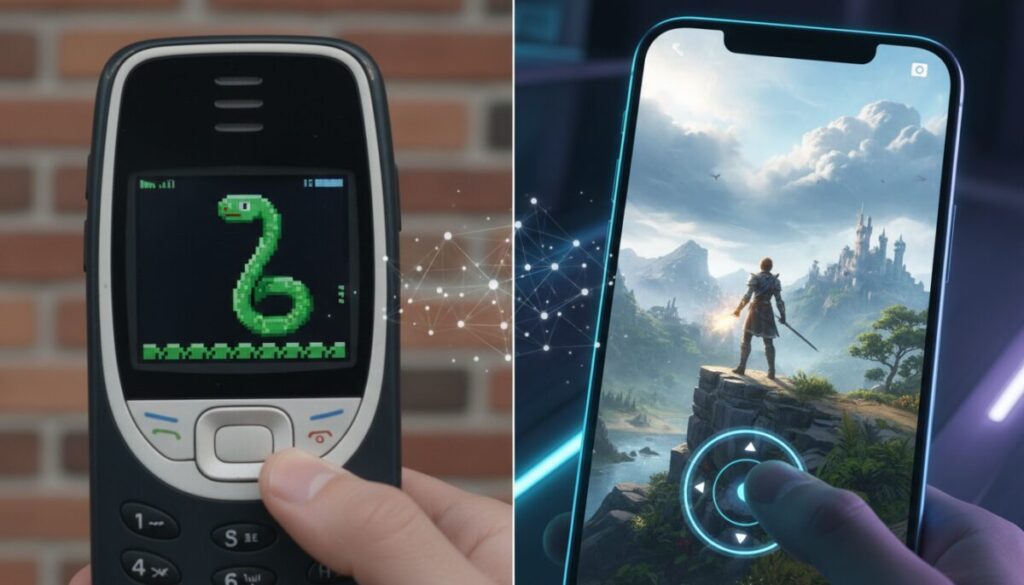
If you stopped to look at your cell phone screen ten or fifteen years ago, you would probably find a jumble of pixels trying to form the image of a snake or, perhaps, a bird being thrown at pigs.
Today, the reality is different. Opening a game on a smartphone often provides a visual experience that rivals what we saw on last generation home consoles.
THE Graphical evolution in mobile games It wasn't just a gradual step, but a technological leap that transformed each of our pockets into a true high-fidelity entertainment center.
The Age of Pixels and the Beginning of Everything
In the beginning, the hardware limitations were brutal. Processors were slow and screens had very low resolutions, forcing developers to be extremely creative with few resources.
The legendary Snake Nokia devices are the ultimate example of this functional simplicity. There were no textures, shadows, or lighting effects; just black dots on a monochromatic green screen.
With the arrival of Java and the first color displays, we saw titles such as Tower Bloxx and portable versions of Asphalt who were already trying to simulate some depth, but still in a very rudimentary way.
The iPhone Revolution and Touchscreen
The launch of the first iPhone in 2007 completely changed the game. The introduction of capacitive screens and more robust processors allowed 2D graphics to gain much more life and sharpness.
Games like Angry Birds and Cut the Rope They weren't technically demanding, but they featured polished art direction, vibrant colors, and fluid animations that older cell phones could never replicate.
At that time, the focus was still on casual gameplay, but visual quality was already beginning to become a competitive differentiator in the emerging app stores.
The Arrival of Realistic 3D on Mobile
The real turning point came when console game engines started to look at the mobile market with interest. Epic Games was one of the pioneers with the launch of Infinity Blade.
Using the Unreal Engine 3, The game featured character and environment models that, for the first time, made people ask, "Is this really running on a mobile phone?".
The use of Normal Mapping High-quality pre-rendered lighting allowed the visuals to closely resemble what we saw on the PlayStation 3 and Xbox 360.
The Role of Engines: Unity and Unreal
We cannot talk about graphic evolution without mentioning development tools. The democratization of Unity It allowed independent studios to create visually rich worlds without astronomical costs.
Meanwhile, Unreal Engine continued to push the boundaries of high-end hardware, bringing particle effects, reflections, and physics that were previously exclusive to gaming PCs.
Success Stories: Games That Redefined Visuals
Some specific titles served as historical milestones in this journey. They were not only beautiful, but they proved that mobile could support complex experiences.
- Genshin Impact: It brought a vast open world with an anime art style that rivals major console productions.
- PUBG Mobile: It adapted a gigantic map and complex shooting mechanics, while maintaining impressive visual fidelity for 100 simultaneous players.
- Asphalt 9: Legends: It raised the bar for post-processing effects, such as motion blur and HDR, creating a sense of cinematic speed.
- Call of Duty: Mobile: It delivered extremely detailed weapon textures and character models, running at 60 frames per second.
- Sky: Children of the Light: A visual spectacle focused on volumetric lighting and realistic clouds, showcasing the artistic side of mobile hardware.
Technologies that Fueled the Graphics Leap
Hardware didn't evolve in isolation. Graphics APIs like the Metal from Apple and the Vulkan On Android, they allowed developers to have direct access to the GPU, reducing the processing bottleneck.
This means that the software can communicate much more efficiently with the phone's graphical "brain," allowing it to render more polygons and complex effects without draining the battery in five minutes.
Ray Tracing in Your Pocket: Has the Future Arrived?
Recently, we saw the introduction of Ray Tracing Hardware-accelerated in chips like Apple's A17 Pro and the latest Snapdragon processors.
This technology simulates the real behavior of light, creating real-time reflections and soft shadows that are the "Holy Grail" of computer graphics. Seeing this on a device that fits in the palm of your hand is surreal.
Advantages and Disadvantages of High-Fidelity Graphics
Not everything is rosy in the quest for perfect graphics. There are trade-offs that both players and developers need to consider when seeking extreme realism.
Advantages
- Immersion: Better graphics help tell deeper and more engaging stories.
- Competitiveness: In shooting games, a higher resolution helps to identify enemies at a distance.
- Production Value: It attracts an audience that previously only played on consoles, professionalizing the mobile gaming scene.
Disadvantages
- Heating: Processing demanding graphics generates a lot of heat, which can lead to thermal throttling (performance drop).
- Battery Consumption: Ultra-realistic games consume energy very aggressively.
- Storage Space: 4K textures take up tens of gigabytes, a problem for devices with limited memory.
- Fragmentation: Not everyone has the latest generation cell phone, which may exclude gamers with entry-level devices.
The Influence of Cloud Gaming
Although local hardware is evolving, we cannot ignore the role of... Cloud Gaming. Services like Xbox Cloud Gaming and GeForce Now allow you to run ultra-demanding PC games on your mobile phone.
Here, graphic processing takes place on powerful servers and is transmitted via the internet. This has changed the perception of what a cell phone "can run," even though technically it's just a receiving screen.
This technology is forcing mobile hardware manufacturers to continue innovating so that native processing still makes sense in the face of the convenience of the cloud.
The Impact of Screens: OLED and High Refresh Rates
The evolution of graphics is not just about what is processed, but how it is displayed. The transition from LCD screens to OLED and AMOLED It brought perfect blacks and endless contrasts.
Furthermore, the update rates of 90Hz, 120Hz or even 144Hz They made the perception of fluidity much greater. A game can have incredible graphics, but it's the high frame rate that makes the movement seem natural.
What to Expect in the Coming Years?
The trend is for the barrier between mobile and console to continue to disappear. We are already seeing direct ports of console games, such as... Resident Evil Village and Death Stranding, running natively on modern smartphones.
The next big step will be the massive integration of Artificial intelligence for image upscaling, similar to Nvidia's DLSS, allowing for heavy graphics at high resolutions with low power consumption.
Augmented Reality (AR) should also benefit from this evolution, creating digital elements that blend into the real world in a way that is almost visually indistinguishable.
Conclusion: The Pocket is the New Frontier
Looking back, Snake's journey to Ray Tracing is nothing short of miraculous. Mobile technology has evolved at a much faster pace than any other platform in history.
Today, your smartphone is not just a communication accessory, but a war machine capable of rendering complex and exciting worlds.
As a writer and enthusiast, I can't wait to see what developers will do with the processing power we'll have in five years. One thing is for sure: pixels have never shone so brightly.
If you're passionate about technology, seize this moment. We're living in the golden age of portable gaming, where the line between reality and the virtual world is just a touch away.